Passive House (Passivhaus)
'Passive House' is an international standard for energy efficient buildings where a house (or any other type of building) is so well insulated and air tight that it can function without a primary heating system. Passive house projects deliver the highest level of comfort, and the most cost effective bundle of energy saving strategies.
Like LEED, BuiltGreen (or other rating systems) there are Passive House organizations, such as PHI, CanPHI, or PHIUS, which can certify buildings - though many projects are built to the standard without going through certification.
In contrast with these other rating systems, the PH rating focuses primarily on comfort and energy consumption (vs. LEED which looks at a wider range of green building issues) but PH goes well beyond LEED in this area - usually resulting in projects that use 90% less energy for space heating than a typical building.
The typical passive house will have very thick walls and roofs, a fairly simple shape, and high performance windows and doors. Typical walls might be 12" to 24" thick (R35 to R60) and roofs might be 18" to 36" thick (R50 to R100). Windows are triple glazed or better, and doors usually have several levels of weatherstripping.
One of the key criteria for achieving the passive house standard is having an airtightness rating less than 0.6 ACH (air changes per hour... i.e. 0.6x the volume of the house). The airtightness is assessed using a blower door apparatus.
The energy efficiency targets were very specifically formulated such that the building sits in the 'sweet spot' which balances construction costs vs. performance. By hitting the energy targets a Passive House can eliminate most of the cost of a conventional heating system (thereby offsetting much of the cost of upgrading insulation and windows).
"Passive House in 90 Seconds" an intro by Hans Jorn-Eich at Pinwheel Building Supplies https://pinwheelbuilds.com/

How is a Passive House different?
Very thick walls and roofs (our typical PH wall is 17" thick)
Very quiet and comfortable, without cold spots or condensation.
Usually a simpler shape (to reduce heat lost through bump outs, dormers etc.)
Very high quality triple-glazed windows and doors
A high efficiency ventilation system with heat recovery (HRV) that brings fresh air to every room year-round.
Many passive houses have recirculating kitchen hoods with charcoal filters that remove smoke, grease and smells.
Many passive houses also use energy efficient 'vent-less' dryers that use a heat pump to extract moisture.
Passive houses can be built with any type of hot water system.
A passive house can work really well with solar panels, but solar panels are not required to meet the PH standard.
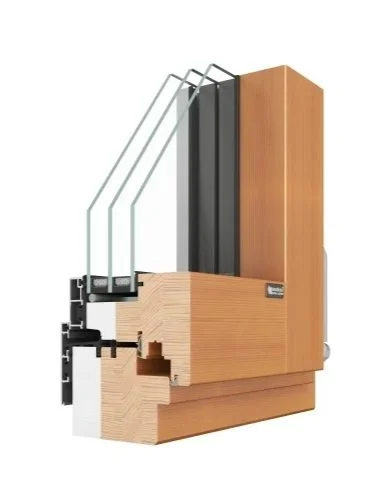
Passive House Window by Vetta Windows

Plaque for the E.37th Passive House
Living in a Lanefab Passive House
Want to live in one of the world’s most energy efficient homes?
Your passive house is ‘Super’:
Super insulated, with R55 walls and R80 roof
Super quiet, with thick walls and triple glazed windows
Super air-tight, with zero draughts
Lanefab is Vancouver’s leading designer and builder of passive house certified homes with 15+ years of experience building comfortable, efficient and high performance homes, many certified by the PHI, international Passive House Institute in Germany.
How is this house different?
This house uses ~90% less energy for heating than a typical house
The house has ~3x as much insulation as a 'typical' North American house, and has windows and doors that are 3x as efficient.
A lot of these energy savings also come from having a draught-free house (so that warm air doesn't leak out, and cold air doesn't leak in)
Unlike a typical house, with a big bathroom fan or a big kitchen hood that blows a lot of air for a short period of time, the passive house’s ventilation system runs 24/7 exhausting a smaller amount of air continuously.
If the house is air-tight, what about fresh air?
Every room in the passive house gets a steady stream of fresh, filtered air supplied by the ventilation system*
Want to open a window? Go for it!
When it’s really cold outside, or really hot, the house will work best with the windows closed (but you can always open a window if you want to feel a breeze or hear what’s going on outside).
The ventilation system also exhausts air from the bathrooms and kitchen (...But no air is recirculated. Bathroom and kitchen air goes straight outside)
If there are smells you want to get rid of, or shower steam, then the bathroom and kitchen exhaust can be ramped up for a little while using the system’s ‘boost’ mode.
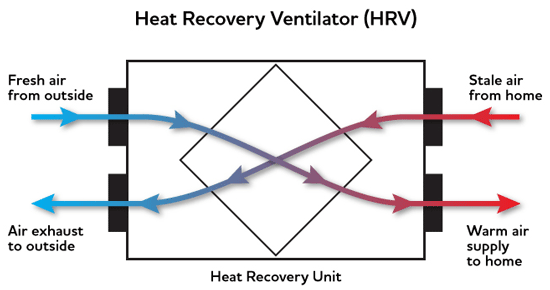
* The ventilation system is an air-exchanger that captures heat (or coolness) from the exhaust air and transfers that energy to the fresh air that is being brought in. This means you always get fresh air, but you don’t lose the energy.
This type of system is called a Heat-Recovery-Ventilator (or HRV) and it uses a heat-exchanger ‘core’ to do the heat transfer.
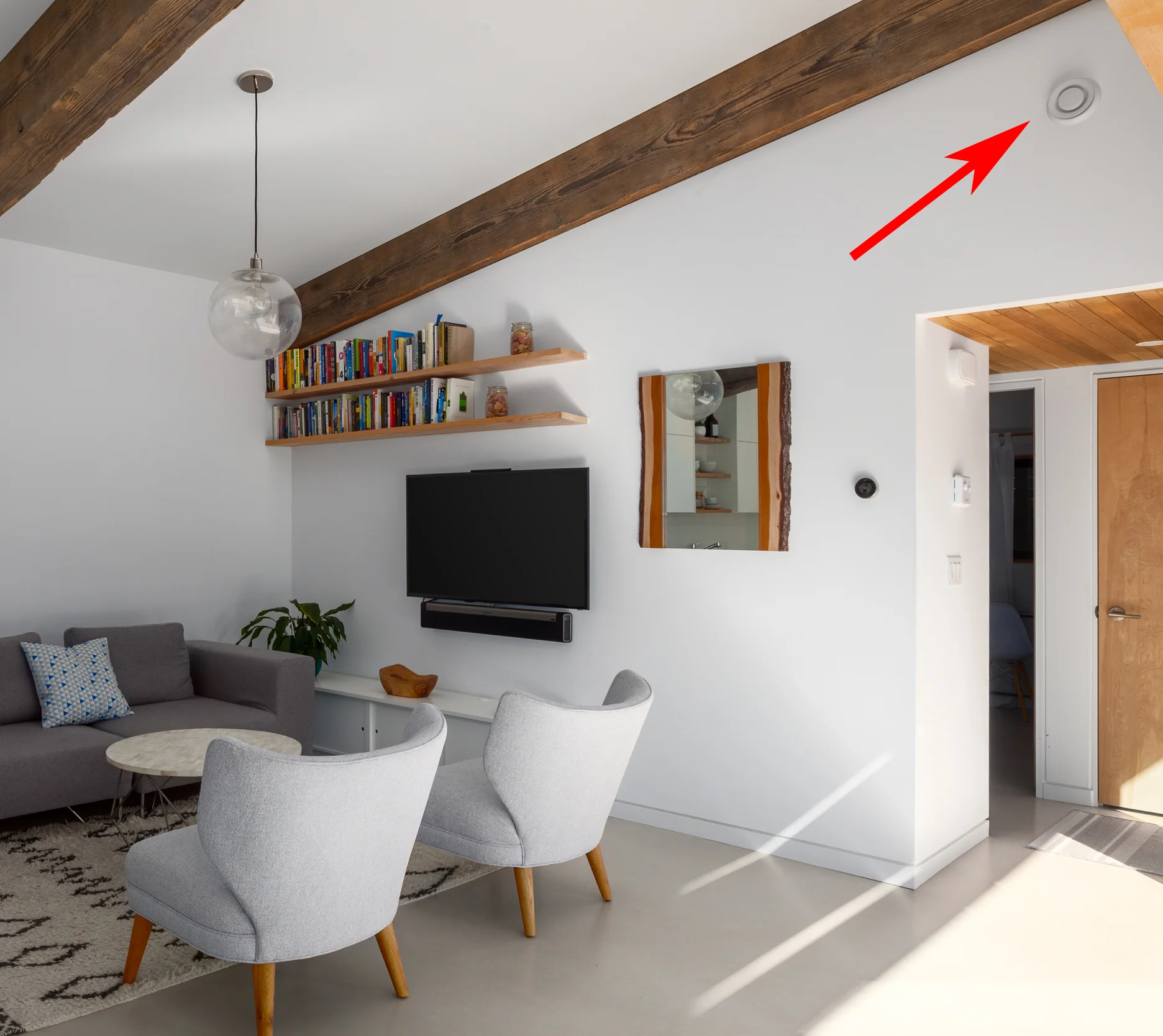
Air outlets on the wall or ceiling supply fresh air to every room.
Moist / stale air is exhausted from the bathrooms and kitchens.
A typical home is like a motor-boat; it burns a lot of energy and moves quickly. It can be very fast to heat up and fast to cool down when using a furnace or air conditioner.
A passive house, by contrast, is like a sailboat, it can do a lot with just a little bit of nature’s energy.
How do you ‘operate’ a passive house?

Winter
During the winter the house will operate most efficiently with the windows closed so that the ventilation system can recycle the home’s heat while still providing fresh air.
On sunny days the house might not need to use it’s heating system at all. On cloudy cold days the heating system will operate like a ‘regular’ house.
Shoulder Seasons.
There are many times during the year when the temperature in Vancouver is very pleasant. You can leave the windows open day and night if you want.
Hottest Summer Days.
During the hottest weeks of the year your passive house will still be comfortable if you take a few steps:
Use your window shades or external blinds during the day
At night, open the windows so that cool night air can move through the house (this is called ‘night-flushing’).
During night-flushing you can also set your ventilation system to ‘summer bypass’ mode*.
When used in ‘summer bypass’ mode the HRV exchanges air but bypasses the core. On summer nights the bypass mode will cool the house more quickly.A passive house that is operated this way will usually stay at a temperate that is roughly the average of the daytime and nighttime temperatures outside. If it’s 28C during the day and 15c at night then the house will be a comfortable 21C (without air conditioning!)
If your passive house does have a small air-conditioning system, then you can run that as needed, but keep the windows closed (just like you would in your car!).
What maintenance do you need to do in a passive house?
Change the Kitchen Hood Filters
If you have a kitchen with a recirculating kitchen hood then you should change the charcoal filters every 6 months to a year (depending on how much you use cook).

Charcoal filters in a kitchen hood can be either round or rectangular, depending on the hood.
